
Technical articles and case studies
Private deployment solution for PoC two-way radio servers
Explains how push-to-talk over cellular (PoC) radios work over 4G/5G and IoT architectures, details the six core server modules, and compares private deployment against shared public platforms.
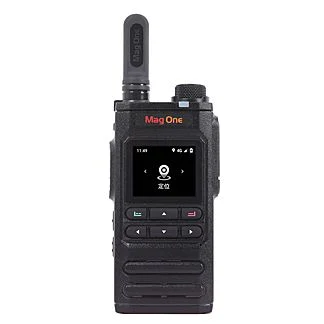
Ongoing national investment in telecom infrastructure—including coordinated tower construction—has expanded 4G and 5G cellular coverage and strengthened connectivity for Internet of Things (IoT) devices. Push-to-talk over cellular (PoC) radios build directly on this infrastructure to deliver wide-area voice communication and integrated dispatch.
Unlike conventional smartphones, PoC radios combine cellular networks (4G/5G) with IoT-oriented system architecture tailored for instant group voice communications and device coordination.
How PoC radios work
- Cellular network transport (4G/5G): PoC radios transmit voice over public cellular networks rather than dedicated narrowband radio frequencies, enabling wide-area coverage without building private radio base stations.
- IoT platform integration: Through IoT platforms, PoC radios exchange data and coordinate with sensors, surveillance cameras, GPS positioning systems, and other smart field equipment.
- IP packet transport and VoIP: Voice is transmitted in IP packets using Voice over IP (VoIP) protocols for fast, stable delivery with low latency, focusing on instant one-to-many group calling rather than standard phone calling.
- Low latency and optimized reliability: Enterprise and emergency PoC systems use optimized communication protocols to maintain low call-setup delay and reliable voice delivery.
Integration with the Internet of Things
- Device-to-device connectivity: PoC terminals connect not only with other radios, but also with industrial sensors, environmental monitors, and remote control systems. In smart factories, for instance, operators can receive real-time machine status updates directly on their terminals.
- Cross-team coordination: Linking PoC platforms with enterprise management, surveillance, and emergency response systems improves cross-department and cross-regional workflows in rescue, logistics, and site operations.
- Automation and smart dispatch: Connected automation equipment can push fault alarms directly to PoC terminals and work with dispatch consoles to assign nearby technicians automatically.
PoC server system architecture
A PoC server system forms the technical backbone of cellular push-to-talk, combining real-time voice routing, user administration, location services, storage, integration APIs, and security controls.
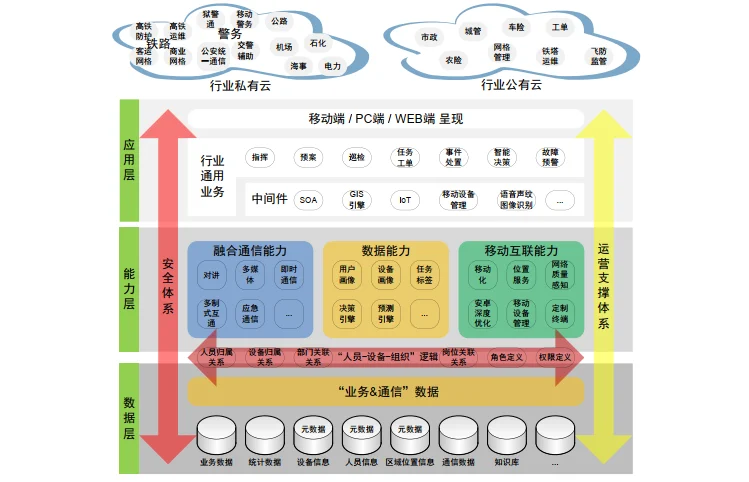
1. Core server modules
1.1 Core communications server
Handles real-time voice processing, forwarding, and resource allocation:
- Routes individual (1-to-1) calls, broadcast (1-to-many) calls, and group communications.
- Maintains low latency and high reliability across concurrent real-time voice sessions.
- Uses intelligent load balancing to preserve stability during peak traffic.
1.2 User management module
Manages accounts, organization structure, and access permissions:
- Supports user registration, login, talkgroup assignment, and permission management.
- Provides multi-tier administration covering enterprise administrators, sub-accounts, and terminal users.
- Records activity logs for operational analysis and auditing.
1.3 Location information service module
Collects terminal locations via GPS and cellular base-station positioning:
- Real-time tracking: Displays live user positions on the dispatch console.
- Route playback: Logs movement history for later review and analysis.
- Geofencing: Defines geographic zones and triggers alerts whenever a device enters or leaves a boundary.
1.4 Data storage module
Archives core operational records:
- Stores voice call recordings for playback and compliance retention.
- Retains user operation and activity logs for auditing.
- Stores historical location and event data to support data analysis.
1.5 Interface and extension module
Provides open integration capabilities:
- Exposes APIs for integrating third-party platforms such as logistics management and emergency dispatch systems.
- Supports IoT connections to surveillance cameras, sensors, and other smart hardware.
- Allows feature extensions and workflow customization.
1.6 Security and encryption module
Protects communications data and server availability:
- Data encryption: Encrypts voice and location traffic in transit against eavesdropping or tampering.
- Access control: Authenticates users so only authorized terminals and operators can access system resources.
- Intrusion protection: Combines firewalls and security monitoring to defend servers against network attacks.
2. Private deployment vs. public operating platforms
PoC servers can be deployed either as a private (dedicated) server or hosted on a shared public operating platform.
2.1 Private deployment advantages
Built and managed exclusively for a single enterprise or organization:
- Higher data security
- Greater customizability
- More controllable communication quality
- Strong operational independence
2.2 Public operating platform advantages
A shared-resource service suited to small and mid-sized enterprises or budget-constrained projects:
- Lower upfront deployment cost
- Rapid onboarding and activation
- Shared infrastructure resources
3. Convergence with IoT
- Smart hardware interconnection: Integrates cameras, sensors, and field hardware with voice dispatch.
- Data analytics and management: Collects, stores, and analyzes operational data to inform decision-making.
- Intelligent dispatch and emergency response: Supports automated alarm routing and rapid incident assignment.
4. Key application scenarios
- Emergency rescue
- Logistics and transportation
- Industrial and enterprise management
- Public safety and policing
5. Summary
Combining real-time cellular push-to-talk with IoT integration makes PoC server systems a versatile tool across modern operations. Private deployment fits organizations with strict requirements for data security, customization, and quality control, whereas shared public platforms offer a fast, cost-effective entry point for smaller fleets.