
Technical articles and case studies
Understanding the Motorola MOTOTRBO product portfolio
An overview of the four generations of Motorola MOTOTRBO radios and repeaters, along with the direct, repeater, and trunked system operating modes they support.
Motorola Solutions introduced the MOTOTRBO digital radio family nearly two decades ago, having begun development in the 2000s. The portfolio has now evolved into its fourth generation. (Exact model designations may vary by country or region.)
Four generations of MOTOTRBO hardware
- First generation — P82 Series: Included portable models such as the P8200, P8260, and P8268, alongside the M82 Series mobile radios and the R8200 repeater.
- Second generation — P86 Series: Introduced a redesigned form factor for the P86 Series portables and M86 Series mobiles, together with the E86 Series portables. Representative models include the P8668, M8668, and E8628. Motorola also launched the SLR 5300 repeater (SLR5300) to replace the R8200, with a substantially updated chassis, alongside other models in the SLR repeater line.
- Third generation — P86i Series: Built on the P86 Series platform with the same exterior design and an "i" suffix; the E86 Series evolved into the E86i Series. Representative models include the P8668i, M8668i, and E8628i.
- Fourth generation — R Series: The latest generation, featuring a noticeably redesigned chassis. Released models include the R7, R2, and R5, with additional models expected to follow.
Operating and system modes
Beyond model generations, MOTOTRBO deployments can be categorized by operating mode:
- Direct mode: Supported by all portable and mobile terminals for direct radio-to-radio calls without a repeater or network infrastructure.
- Repeater mode: Supported by all portable and mobile terminals operating through R-series or SLR-series repeaters to extend communication range.
- System modes: Supported by most MOTOTRBO terminals, though a small number of entry models do not support trunking (verify compatibility for each specific model). MOTOTRBO system architectures include:
- Capacity Plus: MOTOTRBO single-site virtual trunking that combines SLR 5300 repeaters to expand site channel capacity.
- Linked Capacity Plus: Expands Capacity Plus by interconnecting multiple Capacity Plus sites over TCP/IP for multi-site virtual trunking.
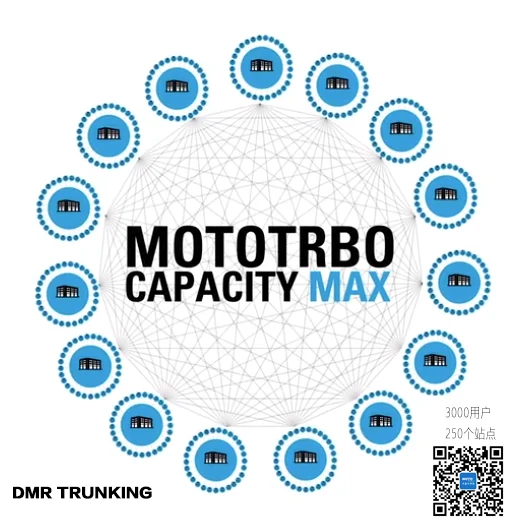
- Capacity Max: Introduces a software-based system controller running on an HP server, supporting substantially greater site and channel capacity than Capacity Plus and Linked Capacity Plus.
- Connect Plus: Predates Capacity Max as a traditional dedicated-controller trunking architecture, requiring dedicated trunking controllers at the site and a trunking option board installed in subscriber radios.